Eat more and weigh less with Volumetrics

May 2, 2012 -- Updated 1116 GMT (1916 HKT)
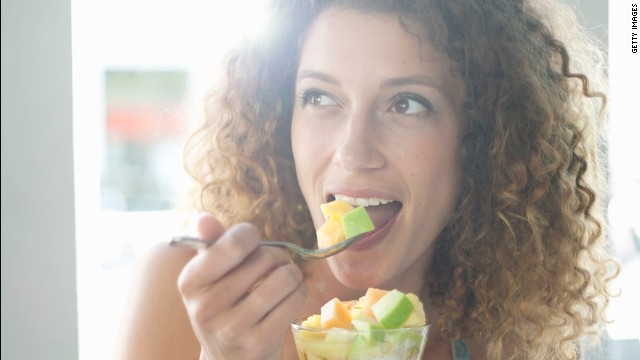
A volumetrics plan helps control hunger by filling you up, but they also do it on fewer calories.
STORY HIGHLIGHTS
- If you're sated after eating, you're likelier to stick with a diet
- Instead of a handful of potato chips, you can fill up on three handfuls of air-popped popcorn
- To create a bountiful plate without adding calories, include ingredients that add water
So what a relief to
rediscover Volumetrics, a way of eating that just plain makes sense. By
pumping up your diet's volume in easy ways (more of that to come), you
will not only enjoy yummy foods, but also eat a lot of them and still
lose weight.
It all comes down to
calories per bite. "By choosing foods that have fewer calories per bite,
your portion size grows, but your overall calorie count decreases,"
explains Barbara Rolls, PhD, the creator of Volumetrics and author of
the new book "The Ultimate Volumetrics Diet". "So you end up with a
satisfying amount of food."
Key word: satisfying.
Rolls, a professor of nutritional sciences at the Pennsylvania State
University, has spent 20 years studying the science of satiety -- that
feeling of fullness at the end of a meal -- and how it affects hunger
and obesity.
Research shows that the
amount of food we eat has a greater effect on how full we feel than the
number of calories in the food. If you're sated after eating, you're
likelier to stick with a diet.
 'Diet goggles' may trick the stomach
 Offices are getting active, healthy
The staples of the
Volumetrics plan -- water-rich foods like brothy soups, fruits and
vegetables, whole grains, low-fat dairy, lean meat, and fish -- not only
help control hunger by filling you up, but they also do it on fewer
calories.
Foods that are high in fat and/or sugar are just the opposite: They're less filling, plus they have more calories per bite.
So the trick is to limit
the low-volume foods and eat mostly high-volume ones. Doing so allows
you to double, sometimes triple, your portions and still lose weight,
says Rolls.
But "volumizing" your
meals isn't simply about piling veggies next to a serving of lasagna or
throwing extra tomato slices or lettuce leaves on your cheeseburger.
It's also about packing your recipes with low-density ingredients.
In a study co-authored
by Rolls and published in a 2011 issue of the American Journal of
Clinical Nutrition, people who ate an entree made up of 25% pureed
vegetables -- in this case, squash and cauliflower were blended into
macaroni and cheese -- consumed 360 fewer calories per "volumize" the
dish, tricking your brain into thinking you're eating more when in fact
you're eating less.
"This simple recipe modification ups your vegetable intake and reduces calorie consumption at the same time," says Rolls.
Pumping up foods with
air also works to increase volume and promote satiety. For example,
instead of munching on a handful of potato chips, you can fill up on
three handfuls of air-popped popcorn for the same number of calories.
The benefit of that sort
of smart swap became apparent during one of Rolls' studies (ultimately
published in 2007 in the journal Appetite). She and her team of
researchers served Cheetos to two groups of women.
One group got the
original Crunchy Cheetos and the other group was given the airy version,
Cheetos Puffs. Because the snacks differed in aeration and, therefore,
volume, the Puffs group ended up taking in 73% more food, but 21% fewer
calories.
Curious to see how you
can pump up your meals and sleek up in the process? Here are Rolls'
rules for putting this science to work for you:
Add fruits and vegetables to everything. Volumizing
sounds time consuming -- all that chopping -- but it doesn't have to
be. Rolls suggests multitasking: Do veggie prep while you catch up with
your kids or partner. In a pinch, buy them ready-to-go. "Markets sell
fresh vegetables already washed, peeled, and chopped," says Rolls.
"Frozen veggies are a good alternative in cooked dishes, and many come
already chopped."
Eat before you eat.
You read that right. Fill up on a low-cal soup or way, you'll get a
head start on your goal (to stave off hunger pangs). But again, make it
easy: Buy ready-to-go bags of salad greens, and stock up on the fixings
for a quick soup -- reduced sodium broth, frozen veggies -- or buy
good-for-you, broth-based ones that are ready-made.
Satisfy your eyes first.
The goal is a full plate. Why? Before you even take a bite, you
subconsciously take in that sight and your brain registers satisfaction.
Realizing you won't be leaving the table hungry makes you less likely
to eat too much of the wrong foods, explains Rolls.
To create a bountiful
plate without adding calories, include ingredients that add water or
extra air such as mousse-style yogurt and puffed rice cereal.
Don't forget protein.
It's key to satiety, but you can eat half a day's worth of calories if
you don't choose wisely. Opt for small portions of low-fat protein,
whether it's skim milk on your cereal, beans on your salad, tofu with
dinner, or lean cuts of beef, chicken, or fish.
Clean your plate (no, really).
Since the goal is to feel full at the end of each meal, this is
practically required. "Other diets ask you to eat less, but we see that
as a half-empty plate," says Rolls. Not to mention a half-empty stomach.

No comments:
Post a Comment